Pilgrimage
As many of you know, I love the movie Spring, Summer, Fall, Winter... and Spring, a film about two monks in Korea. It gave me unrealistically high expectations for Korean Buddhism and gave me an appreciation of ritualized space (see the movie, it's gorgeous and powerful). The movie was shot at Juson pond, an artificial lake created about two hundred years ago that still has several hundred year old trees growing from its depths: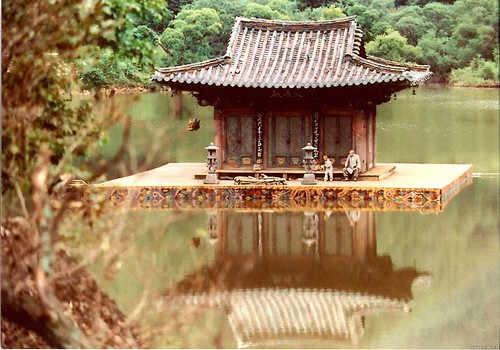
Alanna and I spent an afternoon in the bus getting to Cheongsong, a small city in central Southeastern Korea. The bus stations was absolutely crawling with spiders, which often shared the same webs:
 [note: Alanna took about three quarters of the pictures in this post,
not including the ones from the movie]
The town itself isn't particularly noteworthy except as a gateway to Juwangsan National Park, though it did have this great this great 'Tangible Cultural Artifact' number something or other. (Korea has numbered their national treasures, and I've seen some of the highest ranked ones, like a pagoda in Seoul that is national treasure number three. There are also Precious National Monuments, which include things like the Jindo breed of dog. Everything important to the country is categorized and ranked. National Treasure number one was destroyed by an arsonist about six months before I came to Korea.)


 Early the next day we entered the actual park.
 At the entrance was Deajeonsa temple (both it and the city in which I live have names meaning 'great field').

 This shrine was for a mountain god:
 Outside of it were many dragonflies. I've seen tens of thousands of dragonflies this month. I am surprised that the dragonfly isn't a greater symbol in Korean culture and art.
 Inside another building at the temple complex were these statues:
 Past the temple we followed a stream through a valley between craggy peaks.
 Along the way we detoured to see a couple temples and small caves, one of which held another shrine to a mountain god (you can tell because he has a tiger):


 More mountains, waterfalls, etc:


 We walked along a ridge for a while, and at the highest peak (a modest one, under 900m) we had a nice view over a misty valley.
 From that point on we followed a stream along a path that kept crossing the stream without bridges, so that we spent a lot of time trying to find the best stepping stones across. Finally, we reached a far end of the park, where we had to leave and reenter about a kilometer away to get to Jusan Pond. In the movie, the pond had unearthly beauty:

 In real life it was beautiful, but in a very earthly way:
 I wasn't disappointed; I knew that it wouldn't live up to the view of it enhanced with skillful cinematography. Also, the floating temple and the gateway were only placed in the pond for the duration of the filming and had to be removed afterwards (it's ok to have an observation deck for some reason but not the awesome temple...). Actually, the very real earthly beauty of the place helped me to realize how many places in Korea are incredibly beautiful. I had idealized this pond in my mind, and the reality, instead of decreasing my awe of the pond, elevated my awe of everywhere else. I may not have had as great a sense of enlightenment and spiritual journey as the story's protagonist, but I have in my own way become much more appreciative of my life and experiences.


