Showing posts with label philosophy. Show all posts
Showing posts with label philosophy. Show all posts
Monday, January 17, 2011

Friday, October 15, 2010
Mindfulness and eating
My dinner at Sjávarkjallarinn as a visa commercial:
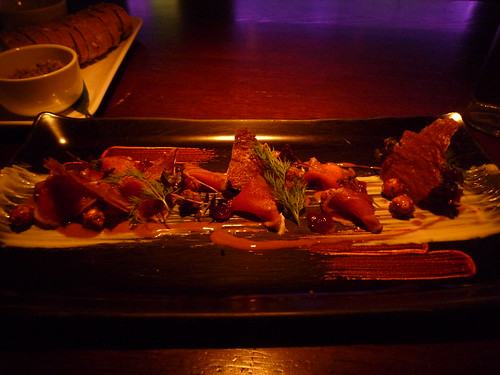
-Sunflower seed encrusted dark bread with mango sauce and crushed peanuts: free
-Slowly cooked salmon with melon salsa, lime jam, and a lime cracker: free
-reindeer carrpacio with cream cheese, cherry jelly, hazelnuts, balsamic cherry glaze sauce and beer oatmeal crackers: 2900 Icelandic Kroner ($23)
-Salmon with garlic potatomash, carrot purre, and asparagus; tuna with a purple potatomash rolled in mixed nuts and zeshuan pepper whipped cream; blue ling with smoked haddock and turmerick mash and artichoke purre; salted cod with peach purre, polenta, and miso foam: 4900 ISK ($38)
-Gianduja chocolate cake with cherry filling, cherries in syrup, pecan crumble, and cherryblossom icecream: 1900 ISK ($15)
-generous (by Icelandic standards) tip for excellent service from a beautiful waitress indulgent enough to write down all of the descriptions she verbalized: 1500 ISK ($12)
-insight into the nature of experience: priceless
I realize now that I had approached the gourmet food experience in entirely the wrong way up until this dinner, as epitomized by my annoyance at the price to quantity and quality disparity the night before. I had always evaluated food by how much good food you could get for how little money. This night, however, I decided to forget price entirely and simply order whatever looked good. In doing so I realized why gourmet food is so delicious. It isn't really the better ingredients, the expertise put into it, the presentation, the atmosphere, the service, etc. What gourmet meals really do is to get you to think that your meal is worth the outlandish price you are paying. I always did this backwards: I tasted the food and then tried to evaluate what it was worth. The better way is to decide that the food is worth what you are paying for it (or more) and then be determined to get that much pleasure out of it. If you think every mouthful of the meal you are eating is worth as much as an entire meal at another restaurant you don't just wolf down your food and you don't half pay attention to it while you watch TV or listen to your dinner companions or think about what you are going to do later that night; you give your full attention to the taste and texture of the forkful of food in your mouth.
My favorite idea from Buddhism is the concept of mindfulness, of truly experiencing the present as it happens and to completely paying attention to it. Life is so much richer and more enjoyable when you can get into a mindful mindset: you see profound beauty in the smallest details that you would never even notice otherwise. Gourmet food essentially is a foray into mindfulness for non-Buddhists. When I realized this I also realized that I don't need the gourmet price tag to experience the pleasure that a foodie gets from a gourmet meal. A fifty cent mango now brings me more joy than any meal could ever had given me before. The money I spent on this meal was a minuscule price to pay for this new perspective where every morsel, every sip of water, is priceless.
Thursday, October 7, 2010
Practical philosophy
Goddamn I love smbc comics:


Saturday, July 31, 2010
Babelfish Quotation Contest
As the first step in resurrecting this blog after my summer hiatus, I just spent some time removing a bunch of irrelevant comments written in Chinese. Most of them, according to the babelfish translations, were the sort of aphorisms that one finds in non-fortune fortune cookies, though I kept this one because of its sheer absurdity. In honor of such tortured translations I give you some quotations run through the babelfish grinder of disparate languages. Anyone who can identify a majority of the original passages will receive some weird Korean socks or t-shirt or something.
- Anger from Peleus' That they are seen; To sing; ? the son of Achilles? Corp
- ? , l' In the winter we are l' not quickly; York's this son completes brilliance summer; And tumbles our boezem house deep l' All clouds; Sea which buries. Will be that as it may our brow will be the compulsion with triumphal returns the type crown, our bruis? dwapens is the monument in the happy conference, our fearful above has hung, is severe we to change in the summit startled to the god measure. Grim-visaged war hath causes front which it corrugation smooth, with the present, but is not the bar corceles bed's restoration to the frightened fearful match soul, his they jump for joy nimbly in lady' ; Enchanting satisfied d' s room; la? d. But I that morning n' One forms for the acrobatics shows off also does not do seeks kijken-glas which is infatuated with; Difficult wish in the morning? I, with love' ; To support s grandly before the destructiveness takes a walk nimf; I makes a mistake reduces this honest part the characteristic to disguise the nature in the morning, in house torsional buckling, incomplete, delivers goods, in me in this world?? Breath, before the average summit it makes maigrement, and one? Lame and not fashionable that outer covering dog from j' It passed by they, as a result of I, in the little North America aborigine? Fights this? Time, vanishing, only if?? n' It has the delight, looks at the tree shade in? Under light and discant alone abnormal. And, because I am impossible? Maintains these honest day welsprekende France to minnaar, I must?? Clearly to determin? d and hatred larceny commodity these several day of genoegens is useless.
- J' Therefore you thought that there is I,
- All sciences in order to state the foundation for the future business of the philosopher now hardly the class structure of value must decide a problematic value, in order to create this forces.
- This was our paradoxes: Because each approach can approach constitute because it matches guide with guide, it was not possible to decide. Answering was as follows: If everything can constitute, in addition guide, as for matching that it is possible to constitute in order to deny. And with that kind of method as for that it does not give here and/or denies either agreement.
- This time as for me always war direction the mixed breed which wins is not that for thing country the fact that you remember is desired in order to die. That wins for the country that of extreme cube the relative direction which forms has another bad mixed breed. People, completely you dell' This substance which has the felt to; In order to speak; America to the war which remains because from war is not many letame here of the horse. The American loves traditionally in war. The American of all substances loves the fact that fight drives out. When being small at one, those entire [vosshkhiti those] l' The pointer of the marble highest at times many of player sulky master and the boxer of the range of the large alloy quickly. The conquest person dearly, there is no American, but the fact that it loses is not approved. The American plays in order always to win. As for them protest nell' It did not become; Give; l' Hell of for the sake of; There is a person who is gone. This, because in order the war which the American never is lost and to lose because never it has. Because the thought which many should lose in the American it is hated.
- That's why I say, I, like every American I'm speaking with, we're ill about this position that we have been put in where it is the tax payers looking to bail out, but ultimately, what the bailout does is help those who are concerned about the healthcare reform that is needed to help shore up our economy, helping tho— it's got to be all about job creation too, shoring up our economy, and putting it back on the right track, so healthcare reform and reducing taxes and reigning in spending has got to accompany tax reductions and tax relief for Americans. And trade, we've got to see trade as opportunity, not as— competitive— scary thing, but one in five jobs being created in the trade sector today, we've got to look at that as more opportunity. All those things under the umbrella of job creation. This bailout is a part of that.
- Because in way that is as this serious age?
- As love god punishes our feeling of the pride
Friday, January 29, 2010
Chuseok vacation day 1 part 2: Songnisan National Park
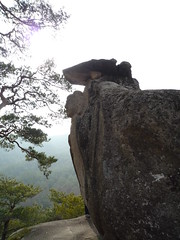
After exploring Beopjusa, I went further into the park. It was quite pleasant to be truly alone for a while (Korea's population density gets to me sometimes.) The leaves were only changing on a few of the trees even though it was October, but those few trees were a vibrant red. It was a warm and pleasant walk, though the path became hard to find when in joined up with a rocky riverbed. In the riverbed I saw a snake, which was especially fun since one hardly sees any sort of wildlife in Korea. I missed the point where the two diverged again and so had to cut across the underbrush to get back on a trail. I finally got to the top of a mountain and saw a marker at it's very top, about thirty feet above me. I brilliantly decided that if workers could climb up there to place the marker, then I could get up too. I started climbing along the crevice between the two halves of the stone dome and was most of the way up when I couldn't make it up any farther. I was afraid for a few seconds that I would slide down the steep rock face, but I managed to get back in control and ease my way back down. After catching my breath and seeing that my wounds were superficial, I dropped my pack, tightened my boots, pocketed some gummy bears, and went back up. It was much much easier without the encumbrance of the pack putting me off balance. After enjoying some ursine delights, I climbed back down and headed on my way.
Unfortunately, because of my earlier time off the path, I was wrong about where my way was. I thought I was on one end of a loop of mountains and that I should continue to the highest one, when it turns out that I was already on the highest of the mountains which was on a dead end from the rest of the loop. I couldn't find the trail going East (because there wasn't one), but since trails are often hard to find on the very tops of mountains I (again, brilliantly) decided to cut through the brush around the rocky top part and meet up with it, which would have worked had there been a path to meet up with. Instead, I found myself on top of a series of small cliffs. At one point I was walking on a narrow ledge looking across a small ravine (about a 20 foot drop) and was calculating that I could jump over it as long as I didn't hit the rock wall on my left or the tree right next to it or tumble past it and off the continuation of the ledge to my right. I was actually about to jump (apparently I was in a reckless mood) when a part of my brain screamed "What am I doing?!?" rather like Bugs Bunny does as he is about to hit a bomb with a sledgehammer in the gremlins episode. I probably would have made it, but I also probably would have died if I didn't, so I think I made the right call even if there had been a path there.
I backtracked my way onto the path and followed it until I came to a three way intersection, at which point I realized where I was. The sun was getting low so I jogged along the rest of the loop, briefly stopping at the other smaller peaks without even pausing for gummy bears. As the sun went behind the mountains I saw an animal running from me into the underbrush. I didn't see it very well, but it looked like a hairy pig and may indeed have been a wild boar (the do exist in Korea and are delicious, but we'll get to that in a few months), though it may just have been a really lost dog whose legs didn't bend much as it ran. After a while it became too dark to be safe to jog anymore, but I realized that if I didn't go quickly it would be fully dark and I wouldn't be able to see the path at all and would be hopelessly lost for the night (I didn't have a light with me), so I compromised and jogged during the straight dirt parts and walked when the path was rocky or otherwise dangerous. At about this point I promised the mountain gods a sacrifice if I made it to the road before full dark.
I should explain. For a while I played with the idea of worshiping gods for everyday things, much like people everywhere have for eons before monotheism became so popular. I thought that since there is no truth, why not make things more interesting and live in a Gaiman-esque world full of gods, goblins, and magic. Also, I was watching the TV series Rome, where household gods and sacrifice were quite common. I was struck by scenes from the show where one of the protagonists kills a bug when pleading to the gods or where he reassures his friend that his curse said in anger didn't count because he didn't kill an animal on it. For a few months I was probably the most devout worshiper the Gods of the Street Crossing have ever known as I silently thanked them on my bike rides to and from work or across the city on each dangerous crossing made successfully and when the crosswalk changed in my favor. I have since stopped the practice since I decided that it wasn't enriching my world or making it more magical, but instead felt like I was putting myself in a subservient position to these forces that I myself had invented.
I did eventually find a cement road toward the city. I soon saw an injured praying mantis limping across the road. I bowed and thanked the mountain gods for granting my request as I squished the mantis under my boot.
Ummm... anyway...the pictures for this post start here.

Unfortunately, because of my earlier time off the path, I was wrong about where my way was. I thought I was on one end of a loop of mountains and that I should continue to the highest one, when it turns out that I was already on the highest of the mountains which was on a dead end from the rest of the loop. I couldn't find the trail going East (because there wasn't one), but since trails are often hard to find on the very tops of mountains I (again, brilliantly) decided to cut through the brush around the rocky top part and meet up with it, which would have worked had there been a path to meet up with. Instead, I found myself on top of a series of small cliffs. At one point I was walking on a narrow ledge looking across a small ravine (about a 20 foot drop) and was calculating that I could jump over it as long as I didn't hit the rock wall on my left or the tree right next to it or tumble past it and off the continuation of the ledge to my right. I was actually about to jump (apparently I was in a reckless mood) when a part of my brain screamed "What am I doing?!?" rather like Bugs Bunny does as he is about to hit a bomb with a sledgehammer in the gremlins episode. I probably would have made it, but I also probably would have died if I didn't, so I think I made the right call even if there had been a path there.
I backtracked my way onto the path and followed it until I came to a three way intersection, at which point I realized where I was. The sun was getting low so I jogged along the rest of the loop, briefly stopping at the other smaller peaks without even pausing for gummy bears. As the sun went behind the mountains I saw an animal running from me into the underbrush. I didn't see it very well, but it looked like a hairy pig and may indeed have been a wild boar (the do exist in Korea and are delicious, but we'll get to that in a few months), though it may just have been a really lost dog whose legs didn't bend much as it ran. After a while it became too dark to be safe to jog anymore, but I realized that if I didn't go quickly it would be fully dark and I wouldn't be able to see the path at all and would be hopelessly lost for the night (I didn't have a light with me), so I compromised and jogged during the straight dirt parts and walked when the path was rocky or otherwise dangerous. At about this point I promised the mountain gods a sacrifice if I made it to the road before full dark.
I should explain. For a while I played with the idea of worshiping gods for everyday things, much like people everywhere have for eons before monotheism became so popular. I thought that since there is no truth, why not make things more interesting and live in a Gaiman-esque world full of gods, goblins, and magic. Also, I was watching the TV series Rome, where household gods and sacrifice were quite common. I was struck by scenes from the show where one of the protagonists kills a bug when pleading to the gods or where he reassures his friend that his curse said in anger didn't count because he didn't kill an animal on it. For a few months I was probably the most devout worshiper the Gods of the Street Crossing have ever known as I silently thanked them on my bike rides to and from work or across the city on each dangerous crossing made successfully and when the crosswalk changed in my favor. I have since stopped the practice since I decided that it wasn't enriching my world or making it more magical, but instead felt like I was putting myself in a subservient position to these forces that I myself had invented.
I did eventually find a cement road toward the city. I soon saw an injured praying mantis limping across the road. I bowed and thanked the mountain gods for granting my request as I squished the mantis under my boot.
Ummm... anyway...the pictures for this post start here.
Tuesday, August 18, 2009
Pilgrimage
As many of you know, I love the movie Spring, Summer, Fall, Winter... and Spring, a film about two monks in Korea. It gave me unrealistically high expectations for Korean Buddhism and gave me an appreciation of ritualized space (see the movie, it's gorgeous and powerful). The movie was shot at Juson pond, an artificial lake created about two hundred years ago that still has several hundred year old trees growing from its depths: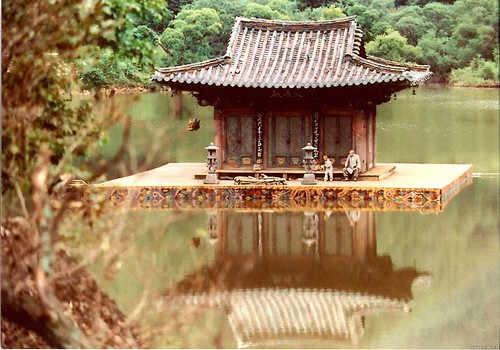
Alanna and I spent an afternoon in the bus getting to Cheongsong, a small city in central Southeastern Korea. The bus stations was absolutely crawling with spiders, which often shared the same webs:
 [note: Alanna took about three quarters of the pictures in this post,
not including the ones from the movie]
The town itself isn't particularly noteworthy except as a gateway to Juwangsan National Park, though it did have this great this great 'Tangible Cultural Artifact' number something or other. (Korea has numbered their national treasures, and I've seen some of the highest ranked ones, like a pagoda in Seoul that is national treasure number three. There are also Precious National Monuments, which include things like the Jindo breed of dog. Everything important to the country is categorized and ranked. National Treasure number one was destroyed by an arsonist about six months before I came to Korea.)


 Early the next day we entered the actual park.
 At the entrance was Deajeonsa temple (both it and the city in which I live have names meaning 'great field').

 This shrine was for a mountain god:
 Outside of it were many dragonflies. I've seen tens of thousands of dragonflies this month. I am surprised that the dragonfly isn't a greater symbol in Korean culture and art.
 Inside another building at the temple complex were these statues:
 Past the temple we followed a stream through a valley between craggy peaks.
 Along the way we detoured to see a couple temples and small caves, one of which held another shrine to a mountain god (you can tell because he has a tiger):


 More mountains, waterfalls, etc:


 We walked along a ridge for a while, and at the highest peak (a modest one, under 900m) we had a nice view over a misty valley.
 From that point on we followed a stream along a path that kept crossing the stream without bridges, so that we spent a lot of time trying to find the best stepping stones across. Finally, we reached a far end of the park, where we had to leave and reenter about a kilometer away to get to Jusan Pond. In the movie, the pond had unearthly beauty:

 In real life it was beautiful, but in a very earthly way:
 I wasn't disappointed; I knew that it wouldn't live up to the view of it enhanced with skillful cinematography. Also, the floating temple and the gateway were only placed in the pond for the duration of the filming and had to be removed afterwards (it's ok to have an observation deck for some reason but not the awesome temple...). Actually, the very real earthly beauty of the place helped me to realize how many places in Korea are incredibly beautiful. I had idealized this pond in my mind, and the reality, instead of decreasing my awe of the pond, elevated my awe of everywhere else. I may not have had as great a sense of enlightenment and spiritual journey as the story's protagonist, but I have in my own way become much more appreciative of my life and experiences.

Monday, August 3, 2009

Friday, June 19, 2009
Potential
Before I decided to come to Korea, I spent a long time deeply depressed due to my attempts to figure out what I was doing with my life. I was terrified of setting myself on a career path, and wanted to opt out of the whole system, and I think I'm beginning to be able to put into words why.
All the jobs I've ever wanted don't exist. As a child I was sure that starship commander, ambassador to an alien race, or robotics engineer would be available to me as career options. I've always known that I was more intelligent than those around me, and because of this I thought I had world-altering brilliance instead of recognizing the reality that I was very bright in a dull town and school system. My family and teachers always gushed over my potential. They seemed so confident that I would do something important and amazing, and they encouraged me with the oft told lie that I could be anything I wanted when I grew up with the result that I don't want any jobs that actually exist because they all fall lightyears short of my expectations. Now the times I spend sleeping in gutters are the highlights of my life. I have worked about a dozen shitty short term jobs to avoid having to face the fact that I will never explore the far reaches of the galaxy, or even live on the moon.
Another part of my dissatisfaction with careers is that I think that the current conception of jobs is growing ever more anachronistic. As far back as I can remember I have worked under the assumption that advances in technology and increases in population would make work unnecessary for most people. I think this is why I am so open to socialism: I think that in the near future there will be far less work that needs to be done than what would be sufficient to occupy people, and I don't like the idea of just inventing useless busywork to fill the ever growing gap. I have recently come to realize how unusual that assumption is, especially when talking to people a generation or two older than me. I have a tutor student who is the parent of one of the children at my school, and she was telling me about what a big problem old age was in Korea. People have been saving on the assumption of a shorter lifespan than the current average, and so they have come to need jobs in their old age, and there are no jobs available. The difference in our world views became clear to me as I was thinking how the problem was that society is stuck on the idea that people need to perform full time jobs in order to have their basic needs met when really we could all work less if we were willing to stop obsessing over careers and stop associating people's worths with their level of employment, whereas she saw the problem as being that people live too long now. With my assumption socialism seems nearly inevitable, with the only alternative being people doing things that were totally useless to themselves and others (and almost certainly devastatingly consumeristic). I'm beginning to see why many people have major issues with socialism since while I take it as a basic assumption to take into account whenever contemplating the future that there will be a massive gap between the work that needs to be performed and the available workers, the idea has clearly never even crossed their minds. It was one of those moments when I recognized a core assumption as what it was—an assumption—which let me recognize that it might not be shared.
In the meanwhile, though, I am performing the busywork of teaching English in a part of the world that will probably overtake the English speaking world in importance and prominence in the near future. However, I don't really think of myself as an English teacher, but as a world traveler, which is a job title that is probably as close as I can possibly come to living up to my childhood imaginings.
Update: I should mention that my musings on potential were influenced by this comic.
Monday, June 15, 2009
Existentialism and parenting, part 3
I had an odd thought today.
One of my kindergarten classes--Pluto--is particularly difficult. There are several hyperactive and attention deficit children, about four troublemakers, two others who cannot handle the troublemakers in a remotely appropriate manner, and a couple hard working smart kids (who make it difficult because without the we could just move at a slower pace). About five minutes into that class today a shy little girl named Tiffany started crying and didn't stop. I did my best to comfort her while corralling the others and trying to get them all to understand and do math problems. After the class I sat in the hall with Tiffany for about fifteen minutes with her sitting in my lap crying into my shoulder while I hugged her (a Korean teacher managed to get her to say what was wrong in Korean, and it turns out one of the boys had done something to her, but by this point--an hour later--she actually didn't remember the particular cause). While her little hand held my finger I realized that she really was comforted by my sitting with her, hugging her, and rubbing her back. I also had the odd thought that I would be a pretty good dad.
Here's the flip side of the problems existentialist beliefs cause for parenting: my nihilistic world view actually gives me qualities that are good in a parent. I have gained incredible patience; I don't let things frustrate me anymore and I try to enjoy every moment of my life regardless of my circumstances, so instead of getting impatient or bored I was able to calmly just be there for a child when she needed it. When you don't think anything matters it also means you don't get angry about people 'wasting' your 'precious' time that could be used to do 'worthwhile' things. Also, I have become infinitely more understanding of other people in the last few years. Other people still baffle me in many respects, but I have come to accept that and to understand to some degree. When I believed in objectivity I thought that there was a right way and wrong way to act, and even a right way and wrong way to think about things and value things. Now that I have come to view other value systems as legitimate (i.e. not wrong), I am much better at seeing things from other people's perspectives, which both helps me not get frustrated with them for being 'irrational', and to better understand what they really want and why.
I still don't think I'm a very good teacher because I'm not very good at managing the children as a group and balancing their various skill levels and needs, but I'm very good with them one on one. I'm less patient when they are in groups because it bothers me that they are disrupting the studies of others (something I always hated in public school), but I can deal with even the most difficult kids on an individual basis, which again, makes me think I'd be a pretty good father, assuming of course I didn't end up with septuplets or some hideous litter like that. Working with children, my increasing distance from actually being a child, and my nihilism have all made me change my feelings on having children from sheer horror to ambivalence, which is really a huge turn around if you think about it.
On a tangentially related note, I have learned a Korean sentence that I look forward to using with every missionary that knocks on my door or tries to force literature into my hand as I wait for the crosswalk light to change: "Jeonuen mooshinronja-imnida," that is, "I am a nihilist."
Friday, June 12, 2009
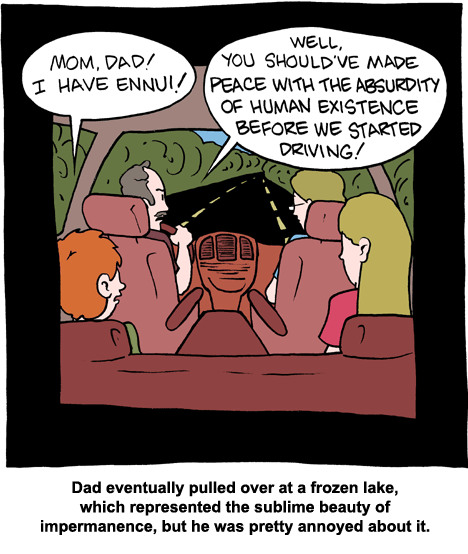
Existentialism and parenting, part 2
(once again taken from the glory that is Saturday Morning Breakfast Cereal Comics)
Thursday, June 4, 2009
Logic and morality, or why I hate Vulcans
I saw the new Star Trek movie a few weeks ago, and there is one scene that has been scarred into my brain because it struck so close to home. As a child Spock answers various questions of logic, mathematics, and physics. He also answers an ethics question with "it is morally praiseworthy but not morally obligatory." The fact that this answer is given is a series of questions that are all treated the same way and answered with the same conviction perfectly capture the Vulcan idea that morality and the best action in any given situation can be derived from logic. My dad is a serious trekkie (well, about the original series, but none of the spin offs), and I grew up with Star Trek as a constant background. My dad clearly admired the Vulcan mindset and instilled in me the value of logic to the exclusion of emotion, which made me insufferably moralizing for a while, and then completely broke me when the drive to learn the truth undermined my very reason for doing so. By the end of my Sophomore year and the beginning of my Junior year I had completely devoted myself to trying to live in (what I took to be) accordance with pure logic and reason. When I saw that this position was itself illogical it all fell apart.
Basically, what I'm saying is that I blame Star Trek for why my head was so fucked for years. Well, I think it was worth it to get where I am now. It is a little discussed phenomenon that if you are lucky there is existential joy on the far side of existential angst.
Thursday, February 19, 2009
Temple stay
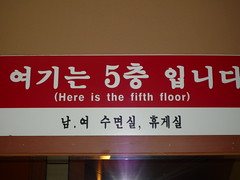
Jeff, Maddy, Bo, and I went up to Seoul Friday the 13th on the KTX. The KTX provided fond memories of the trains in Germany and France, reaching speeds of 300km/hr. Once we arrived we stayed at a spa. The spas here have saunas, hot and cool pools, and other pools supplemented with interesting things like mugwort and yellow (sulfurous) sand. The spas are separated by sex and we all walk around in the nude. In the area open to both sexes there are restaurants, arcades, and then there are segregated sleeping areas, which were rows of 6'x3'x3' cubbies with mattresses and pillows (of sorts). Also, they apparently have a harem:
 In the latter sign I think they meant 'please check your pockets for money or other belongings before returning your clothes' but instead it comes off as sounding like we should leave tips in the pockets of the shorts they give us.
In the morning I took a dip in the cold pool before we navigated our way through the subway system to where we met the bus for our trip. I hadn't seen so many Westerners in months, so it was weird being able to eavesdrop on conversations and realizing that my conversations would also be understood. It's amazing how quickly I got used to being a linguistic minority. I met some interesting people on the three hour ride and had some good conversations.
We were early for the temple, so we stopped for a short walk up to a Buddhist statue and a view of a beautiful river.


 With the conclusion of dinner we went out and rang an enormous bell (it's bigger than the U.S.'s liberty bell) with a mini battering ram. The sound was deep and loud enough that we could feel the vibrations. Back inside we sat in a circle and had a question and answer session with the head monk and two monks of a different Buddhist sect visiting from... umm... (shit, I can't believe I already forgot this) somewhere is Southeast Asia. The visitors spoke a little English but not enough to be comfortable talking about Buddhism in it, while the head monk spoke entirely through the interpreter, so I took everything with a grain of salt. I would have liked to know their opinion on my experience of having been free of (or deprived of, depending on one's point of view) any desires or attachments to the conditions of the world, yet having been absolutely miserable rather than blissful at this time. Obviously the difference between me at my lowest point and a Buddhist at their highest lies in the second order desires about what we desired to desire and our beliefs about metaphysics. They can still act in the face of being without desires for anything material because they think that there is also a non-material world and that they can have a good afterlife if they perform the correct actions in this one. I would have liked their take on it rather than just my speculation as to what they would say, but I didn't want to put the interpreter through that. Amusingly, the head monk had been given a large box of chocolates for Valentine's Day (which it seemed like he had never heard of before) and so shared them with us. Mmmm... Belgian chocolates. Not exactly the best thing to pass around when trying to convince us the world is nothing but suffering, but appreciated (of course in theory we we will feel pain in the absence of chocolate, making things worse). Even the monks had some, which surprised me since they mostly only eat food grown at the monastery.
 Next on the itinerary was 'making a dream pouch with whole-hearted mind', i.e. while only thinking about one thing (your dream or 'desperate wish'). I thought it odd that the focus was on our desires and wishes when one of the tenants of Buddhism that they talked about was removing all desired that were based in the material world. My wish/dream/whatever was something completely dependent upon my own attitudes, and hence is the kind of wish that I think focused thought could actually make come true. We basically
  just threw the finishing touches on some pre-made pouches that were clearly designed by the corporate entity that promotes temple stays rather than anyone at the temple. We were supposed to take our pouches with us up to do our prostration prayers, but somehow I misunderstood/didn't hear that instruction and so ended up at the high shrine without it.
  As I suspected, the areas up the mountain were way more interesting and authentic feeling. The temple at the very top of the mountain was decorated with lanterns and dragons (I thoroughly enjoyed the dragon decorations, as you can probably tell from the number of photos of them here). In it we did 108 prostrations (plus the three we do every time
 we enter a shrine and three we do every time we leave). At some point I'll talk to the religion majors among you about going through the motions of worship without any feeling of religiosity. It actually reminded me a lot of the Muslim service I attended for my Intro to Islam class. When we completed our prayers we ate a snack of delicious steamed potatoes and then re-segregrated by sex for sleep.
 The rooms were empty except for sleeping mats and pillows, and so looked strangely vacant to my Western eyes. As Murphy's Law would dictate, the first person to fall asleep was the loudest snorer, but I slept fairly well anyway, which is good because we had an early start to our Sunday.

 We had breakfast (which was an informal meal) and then had the rest of the morning free. I helped a fellow visitor finish his breakfast so that he didn't waste any food, which I probably would have done anyway since I am a natural born scrounger . Then I tried to get some sleep, and quickly gave up. Instead I meditated again for a few hundred breaths and ran out to take some pictures of the grounds in the freshly fallen snow (it started snowing as we left the lotus shrine). My favorite building was the one that was actually pretty ancient. I wish they would have at least put some lanterns over the lights if they really felt it needed electricity. The naked bulbs and speakers looked terrible on the thousand year old wood. After break we made lotus lanterns by putting paper leaves onto pre-made lanterns. Mine is now the only decoration that I have personally added to my apartment (apartment tour forthcoming, someday, I promise). Once we cleaned up we headed back up to the lotus shrine to make prayer bead necklaces. We thought about our desperate wish while doing a prostration and then added one bead to the string, repeating the process until all 108 beads were on the string. The 108 prostrations are for the 108 way of suffering, which are completely exhaustive, so absolutely everything is suffering. They are the six senses (eye, ear, nose, speech, body, consciousness) times pleasant, unpleasant, and neither pleasant nor unpleasant, then the six senses times like, dislike, and neither like nor dislike, and then all of this is multiplied by past, present, and future

 In Seoul Jeff, Maddy, Bo and I went to Itaewon, the foreigner district. Besides seeing these amazing motorcycles, we went to an English bookstore where I bought The Kite Runner and a David Sedaris book. We also had delicious Thai food. Mmm, Thai food. When I get my life in order a little I will tell you more about Seoul, since I also spent this last weekend there.
(Photo credits: all pictures not on my flicker account were taken by Charlotte White)

Subscribe to:
Posts (Atom)